Septimus Warren Smith
Mrs DallowaySeptimus Warren Smith is a young veteran whose experience of war and its aftermath places him in conflict with both ordinary social life and the medical authorities meant to care for him. His story turns on the gap between what he perceives as revelation and what others dismiss as illness: his visions can disclose beauty and connection to him, while doctors reduce his suffering to a condition to be managed. That conflict culminates in his suicide rather than submission to enforced separation and treatment.
Identity and Background
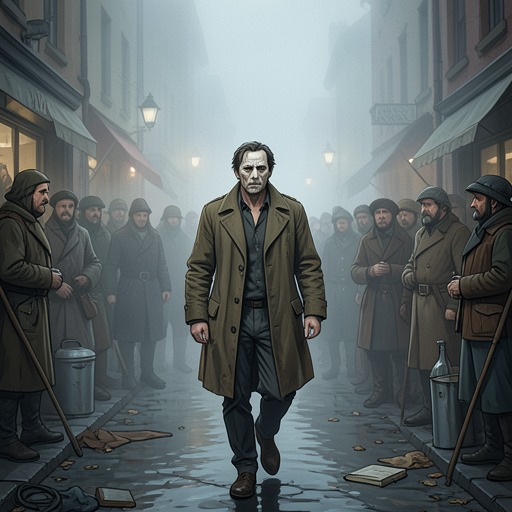
About thirty, Septimus is pale-faced, bead-nosed, and dressed in brown shoes and a shabby overcoat. His apprehensive expression affects even strangers who see him. When traffic stops around a motor car outside Mulberry’s shop, he is caught in the crowd’s stillness and interprets the converging attention as a threat directed at him. He feels rooted to the pavement for an unknown purpose, while the world seems on the verge of bursting into flames. His wife, Lucrezia Warren Smith, urges him to move on, but the scene already shows how an ordinary public moment can become terrifying and charged with significance for him.
Septimus had worked at Sibleys and Arrowsmiths, where his manager, Mr. Brewer, thought highly of his abilities and imagined that he might eventually rise to an important position in the firm. The prospect depended on his remaining healthy; Mr. Brewer saw that he looked weak and encouraged him to play football. The First World War interrupted those expectations. Septimus volunteered early and went to France, driven by a sense of England embodied in Shakespeare and Isabel Pole, a woman he had seen in a green dress walking in a square. The war thus entered the life of a promising young clerk whose attachments to literature and an idealized England helped shape his idea of what he was defending.
War and Its Aftermath
In the trenches, the change Mr. Brewer had hoped exercise might bring occurred at once. Septimus became a soldier, and the war altered his capacity to respond to other people. When his comrade Evans was killed shortly before the Armistice, in Italy, Septimus congratulated himself on feeling little and on remaining reasonable. He treated that apparent lack of grief as evidence of what the war had taught him. He had endured the war, seen friendship and death, gained promotion, and survived; he believed the last shells had missed him. But survival did not mean that the experience had ended. His later distress and the persistent return of Evans in his visions show that the friendship and the death he had thought himself able to dismiss remained active in his mind.
After the war, Septimus was in Milan, billeted in an innkeeper’s house with a courtyard. He became engaged to the innkeeper’s younger daughter, Lucrezia, during a period of panic about his inability to feel. Their marriage brought them together, but it did not resolve the emotional estrangement that his wartime experience had produced. Back in London, his wife tried to turn his attention outward, following Dr. Holmes’s advice that he take an interest in things around him. In Regent’s Park, smoke-writing in the sky seemed to Septimus a message meant for him: beauty appeared inexhaustible, generous, and capable of communicating without words. When a nursemaid explained that the smoke advertised toffee, the same sight held two incompatible meanings—an ordinary commercial display for others, a revelation for him.
Perception and the Search for Meaning
Septimus’s visions are not presented merely as isolated episodes; they organize his attempt to understand what has happened to him and what remains possible. At one point he believes that the supreme secret must be told to the Prime Minister: trees are alive, there is no crime, and love is universal. The effort to put these ideas into words is physically and mentally difficult, yet he feels that the world has been changed by their disclosure. When a dog approaches and seems to him to be turning into a man, the transformation becomes another source of terror. His perception moves rapidly between a conviction of universal meaning and fear that ordinary things conceal a threatening change.
Later, while lying on the sitting-room sofa, Septimus experiences shifting light on the wall, roses, and wallpaper as signs from nature. The scene reaches him through reflections on the Strand and the yellow omnibuses, while the sound of water and birds seems to enter the room. He feels nature repeatedly affirming that he need not fear. The pattern of his experience contrasts with the medical account of his condition: what his doctors regard as excitement or delusion, he experiences as communication, beauty, and a truth about life. Yet his wife sees the strain of this state as well as its moments of apparent happiness. She records his writings about war, Shakespeare, great discoveries, and the claim that there is no death, but finds that they can be beautiful or nonsensical, and that he may stop, change direction, or listen for something new in the middle of expressing himself.
Marriage and Medical Conflict
Lucrezia’s care is shaped by the practical demands of living with Septimus’s distress and by the advice she receives from doctors. When he turns away from her and reacts with alarm to her hand, she wonders whether he has noticed that she removed her wedding ring because her hand had grown thin. Septimus interprets the gesture as proof that their marriage is over: the bond has been cut, and he is free but alone. His conclusion reveals how readily a change in their relationship, even one explained by Lucrezia’s concern about her hand, becomes part of a larger and more absolute story in his mind.
Dr. Holmes examines Septimus after Lucrezia sends for him and tells her that there is nothing seriously wrong. He recommends bromide at bedtime and treats Septimus’s difficulties as compatible with ordinary diversions, such as going to the Music Hall or playing golf. For Lucrezia, this initial reassurance offers relief; for Septimus, the absence of an acceptable explanation deepens his sense that his inability to feel is a crime. He believes that human nature has condemned him to death because he did not care when Evans was killed. What he had once taken as a reasonable response to wartime loss becomes, in retrospect, the source of intolerable guilt.
Sir William Bradshaw gives the condition a more severe clinical name, judging Septimus to be in a complete physical and nervous breakdown. He asks about Septimus’s military service, promotion, work, and financial circumstances, but his assessment does not meet Septimus’s own account of guilt and revelation. When Septimus attempts to say that he has committed a crime, Lucrezia insists that he has done nothing wrong. Bradshaw then learns that Septimus has threatened suicide and orders a long period of rest in a country home, apart from his wife. He describes the problem not as madness but as a failure of proportion, and presents separation as necessary. The order makes care inseparable from control: Septimus is to be removed from the person closest to him and placed under a regimen he does not want.
Septimus remembers Bradshaw’s insistence that the people most loved are not good for the ill and that husband and wife must be separated. He challenges the authority behind the command, asking what right Bradshaw has to tell him what he must do. Lucrezia explains that the decision follows his talk of killing himself, but her explanation cannot turn the compulsory order into an agreement. The conflict is therefore not simply between illness and treatment. It is also between Septimus’s claim over his own life and a system that interprets his resistance as further evidence that he must be managed.
Suicide and Narrative Significance
When Dr. Holmes comes to the house, Septimus believes the doctor will force his way in and that neither Holmes nor Bradshaw will leave him alone. He considers possible ways to die, then settles on the window, while insisting to himself that he does not want death and that life is good. At the last moment, he throws himself from the window. The decision follows the threat of intervention and the prospect of being taken away from Lucrezia, but the novel does not reduce it to a single motive: fear, a desire to preserve his freedom, and his remaining attachment to life coexist in the scene.
Dr. Holmes enters after the fall and calls Septimus a coward. Lucrezia understands what has happened; Holmes tells her that her husband will not recover consciousness and tries to spare her from seeing him. He describes the death as a sudden impulse and says that no one is to blame, while also admitting that he cannot understand why Septimus acted as he did. His response closes the gap between the medical system and Septimus without resolving it: the doctor can manage the aftermath, but his explanation does not encompass Septimus’s experience or the coercive treatment he feared.
Septimus’s arc connects the public consequences of war to private life after the fighting has ended. His inability to mourn Evans as he expects a friend to mourn becomes guilt; the guilt feeds a search for truths he cannot communicate in a form others accept; and medical authority answers his distress by prescribing separation and obedience. His suicide is thus both a death and a refusal of the fate arranged for him. The novel places the beauty he perceives, his wife’s effort to care for him, and the doctors’ confidence in their judgments beside one another, leaving the reader to confront the human cost of a system that mistakes command for understanding.